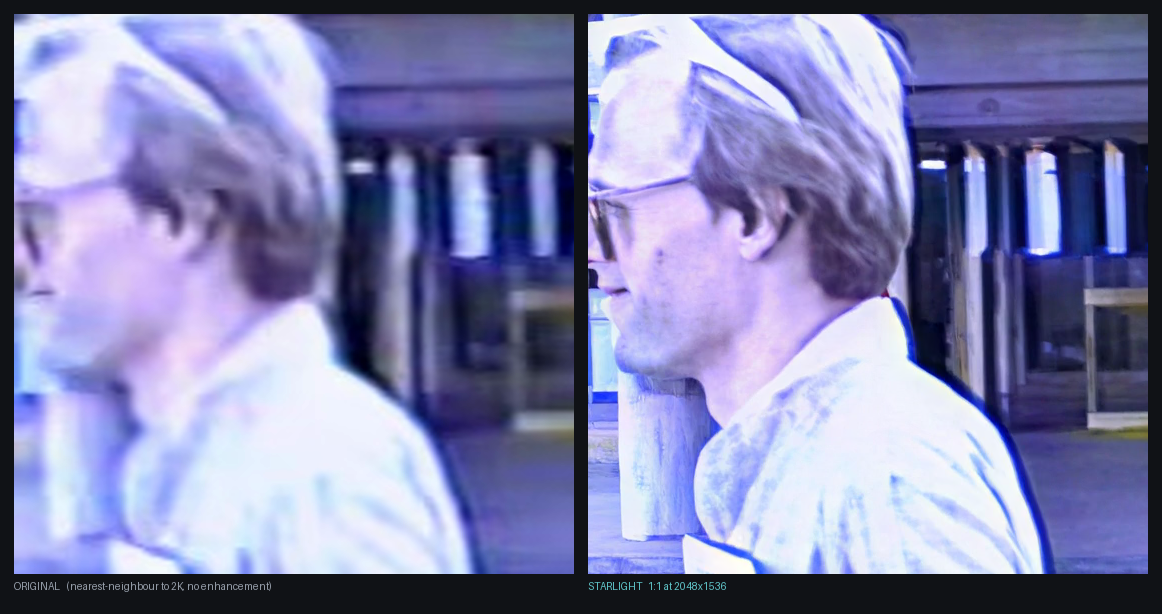
When nearly three hours of 1988 Tanzania safari footage arrived at Pixel 360 Media, it carried the full weight of time: interlacing artifacts, squeezed geometry, faded color, and audio that had grown rough and uneven across its 176 minutes. The digital file had been made from the original tape years earlier, and while that step preserved the content, it also locked in every limitation the source had accumulated. Our job was to change that.
Two decisions shaped this restoration more than any setting did. The first was to leave the camera movement alone. We measured motion across the entire film and found it was already steady: the median is under two pixels a minute, and roughly a third of the footage is essentially locked off. Steadying it would have meant cropping away half the frame to remove a wobble nobody can see, so we did not. The second was to use a single reconstruction pass rather than two. We tested a second pass on a thirty-second section and it invented detail that was never in the original, turning a gravel road into broad flat leaves. The measurements rated that version as the better one, and the measurements were wrong. Reading the picture beats trusting the score.
Everything else was measured against this specific material by hand, with nothing run through a preset. The interlacing came out first, removing the fine comb lines that had cut across every moment of movement. Geometry was restored so that people, animals and the wide Tanzanian savanna hold their true proportions again. Color grading brought the faded cast back to life, restoring true blacks, lifted contrast and natural tones across a film that had gone dull with age. Detail and sharpness were recovered across the frame, and where the tape had lost them altogether they were rebuilt: hair, fabric, foliage and the open landscape backgrounds, with faces handled conservatively so they stay true to the original. Sharpness in the source varied sixteen-fold between its strongest and weakest passages, so the work had to lift the soft footage without over-hardening what was already holding up. The finished picture carries a subtle, natural quality that feels organic rather than over-processed.
One thing worth noting, because it is unusual for tape of this age: we measured for dropout streaks and damaged frame edges and this one came back clean, so no repair pass was needed. The audio received full attention: tape rumble and hiss removed, voices brought forward, and levels balanced across the full running time so quiet passages and louder ones sit at the same comfortable volume. The project was delivered at 2560 x 1440, nearly 80 percent more pixels than Full HD, with an archival 2K master preserved alongside the finished file.
Every recording was shot and stored differently, so what can be recovered varies scene by scene with the condition of the original. We bring the footage as far as it allows, and that is the honest standard we hold ourselves to on every project.
Pixel 360 Media specializes in professional enhancement and restoration for footage of all kinds, from decades-old recordings to more recent material that simply deserves better. If you have footage worth preserving, we would be glad to take a look.
Stay Updated
Get the latest tips on video enhancement, photo restoration, and audio cleanup delivered to your inbox.
No spam. Unsubscribe anytime.