
Most people describe an old photo as "faded". What they are actually looking at is a photo whose tones have collapsed toward the middle. Nothing in it is truly black any more, and nothing is cleanly white. Everything sits in a narrow band of grey, and the eye reads that band as dull.
Recovering that range is the single most valuable thing image enhancement services do to a photo, and it is worth understanding before you pay anyone to do it.
What a Collapsed Tonal Range Actually Looks Like
Every photo can hold 256 levels of brightness, from 0 (black) to 255 (white). A healthy image uses most of them. A faded print uses far fewer.
Here is a real example, measured from a client photo we enhanced.
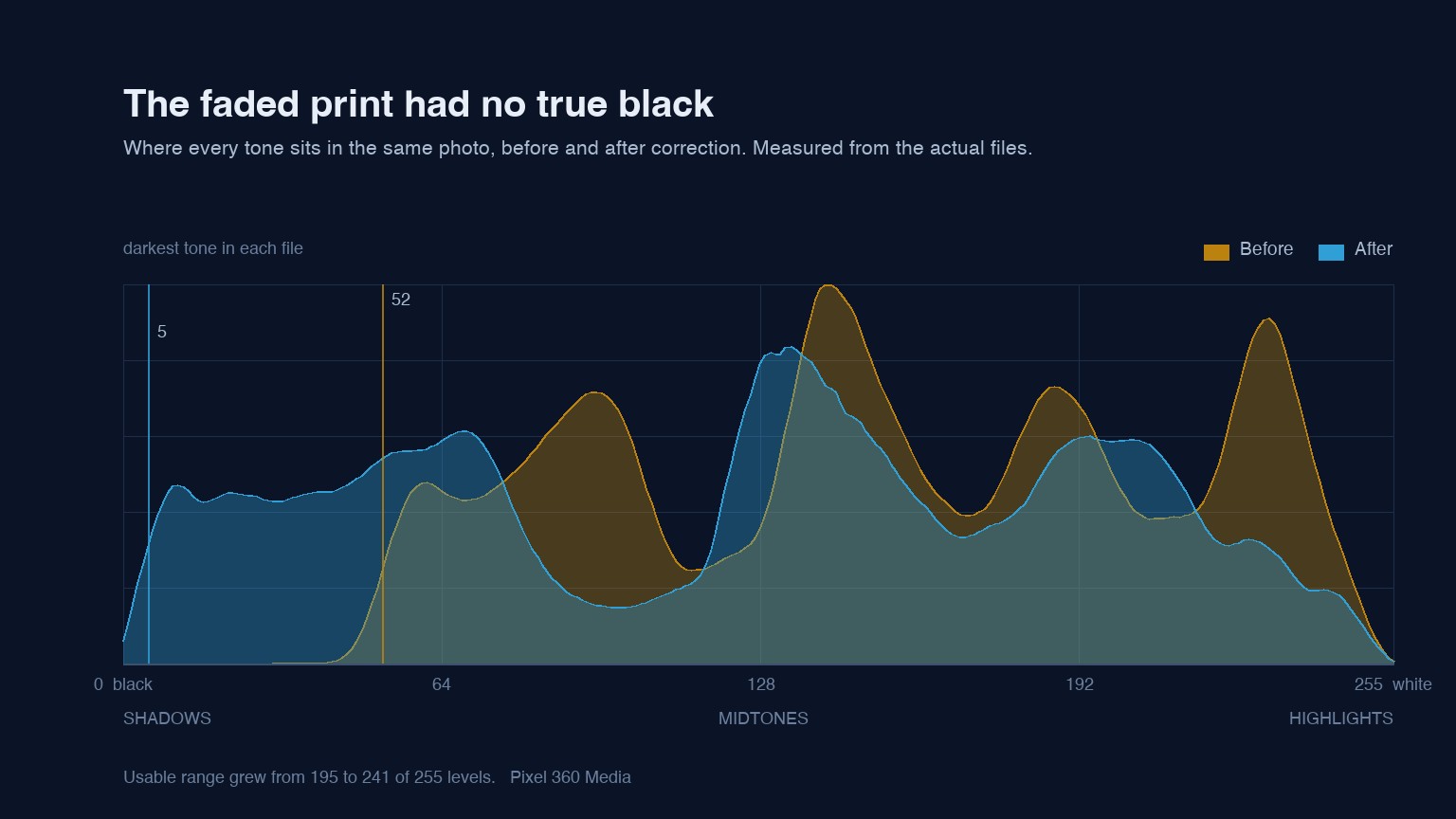
The gold curve is the original print. Look at where it begins: nothing in that photo is darker than level 52. The deepest shadow in the man's suit, the darkest part of the background, his hair, all of it stops at a mid grey. There is no black anywhere in the file.
The blue curve is the same photo after correction. It reaches down to level 5, close to true black, and the usable range grows from 195 levels to 241.
That is why the corrected version looks sharper even though no sharpening created it. Depth is mostly contrast, and contrast needs somewhere dark to push against.
Why the Fix Is a Judgment Call, Not a Slider
The obvious move is to drag the black point until the darkest pixel hits zero. On a lot of photos that is exactly wrong.
Three things have to be weighed on every image:
Where the real black should sit. If a photo genuinely has no black subject in it, a snowy field, a white studio backdrop, forcing one in makes the picture look grubby rather than rich.
What is hiding in the shadows. Pushing the black point down crushes detail below it. On a portrait, that can quietly delete the texture in dark hair or a dark jacket. Recovering range is only worth it if the detail survives.
Whether the fade is even. Prints rarely fade uniformly. Sun exposure, the edge that sat in an album, a water mark, each can shift differently. One global correction leaves the uneven parts looking worse than before.
This is the part that does not automate. A tool can find the darkest pixel in a file. It cannot tell you whether that pixel is a shadow worth keeping or a stain worth removing. That decision is why every image we deliver is reviewed by a person before it goes out.
What This Means When You Buy
If you are comparing digital image enhancement services, it is a fair question to ask how they handle tonal range, and what they do when a photo has faded unevenly. The answer tells you whether you are buying a batch preset or actual attention.
It also sets expectations honestly. Results vary photo by photo with the condition of the original. A print that has faded but held its detail can come back dramatically. One where the detail has genuinely gone will improve, but no process invents information that is not in the file. Anyone who tells you otherwise is describing generation, not enhancement.
See It On Your Own Photo
The measurements above took about a minute. The same read on your photo tells you very quickly whether it is worth restoring.
Send us two or three images, including the one you think is hopeless, and we will enhance them for free and tell you plainly what each one can and cannot become.
Ready to see your own photos measured?
See our photo enhancement service for pricing and samples, or send us a few images for a free preview.
Pixel 360 Media provides image enhancement services including tonal and color correction, detail recovery, restoration, retouching, and upscaling. Located in Westchester, NY, serving clients nationwide through our fully remote platform.
Stay Updated
Get the latest tips on video enhancement, photo restoration, and audio cleanup delivered to your inbox.
No spam. Unsubscribe anytime.